TradingView trading bot · automation
TradingView trading bot — automate your alerts on any broker
Turn any TradingView indicator or strategy alert into a live trade. AutobotSignal receives the alert by webhook and executes it on your connected broker.
Works with any indicator that can fire a TradingView alert
Send TradingView alerts to AutobotSignal
Automate trading on your own rules — your indicator decides the entry, AutobotSignal places the trade.
- 1
Get your signal key
Open the desktop app, go to Signals → TradingView, and copy your personal signal key and webhook URL. The key identifies your account and must appear in every alert message.
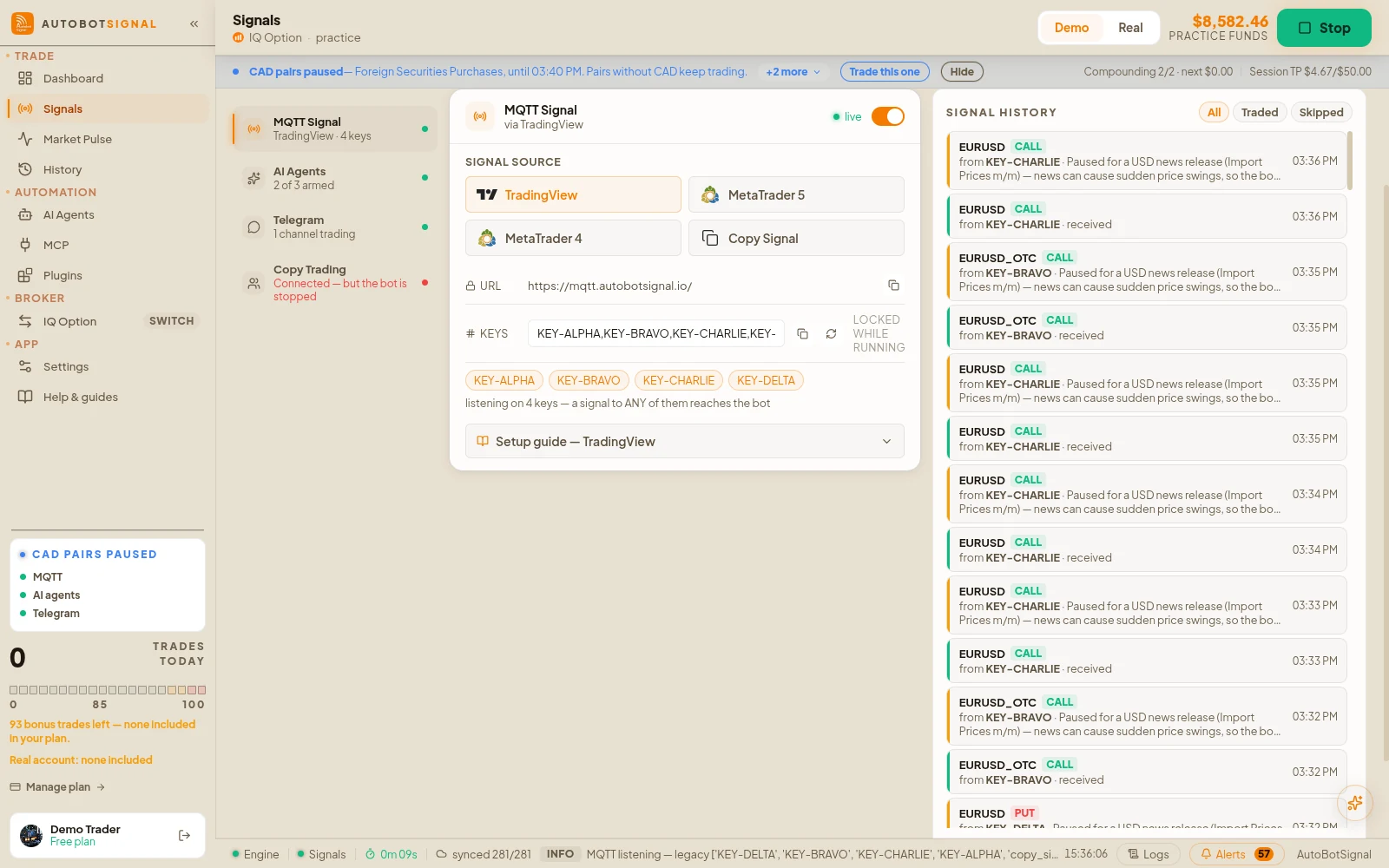
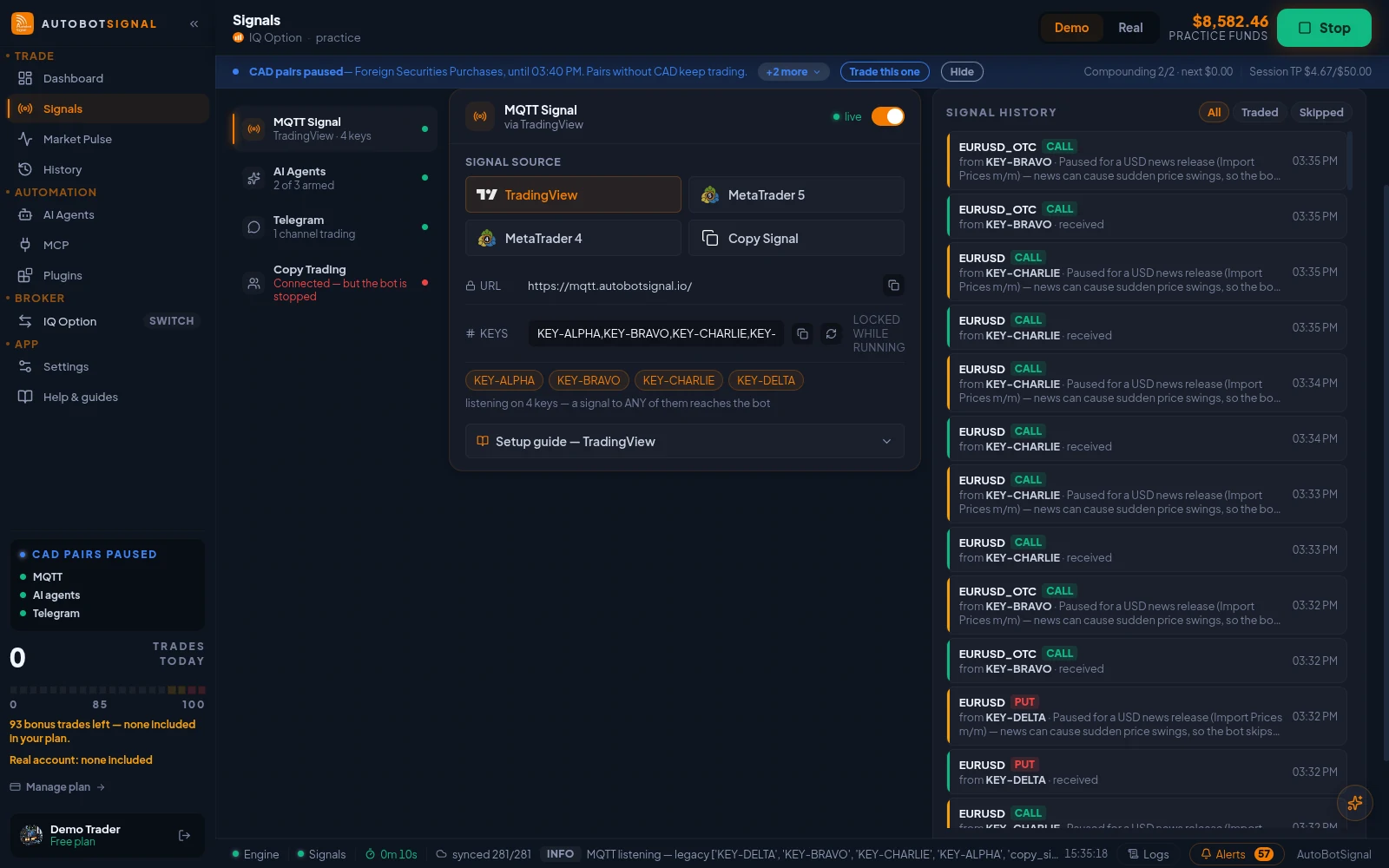
Signals → Sources → MQTT Signal: the webhook URL, your signal keys, and the TradingView, MetaTrader 5, MetaTrader 4 and Copy Signal senders. - 2
Create an alert in TradingView
On your chart, click the alert (clock) icon to open the alert dialog. Choose the indicator condition you want to trade.
- 3
Set the alert condition
In the Settings tab, confirm your indicator is selected and the condition matches the signal you want — for example a crossover or a plotted buy/sell marker.
- 4
Paste the alert message
Use the exact JSON message shown in the app, including your signal key. AutobotSignal cannot interpret free-form text, so the format must match or the alert is ignored.
- Separate messages for buy and sell
- Include the asset, direction and expiry the app expects
- Keep your signal key private — anyone with it can send you signals
- 5
Set the webhook URL
In the Notifications tab, enable Webhook URL and paste the AutobotSignal endpoint from the app. Save the alert.
- 6
Test, then arm
Trigger the alert once and confirm the app shows it arriving. When the parse looks right, connect your broker, set your limits and arm the session.
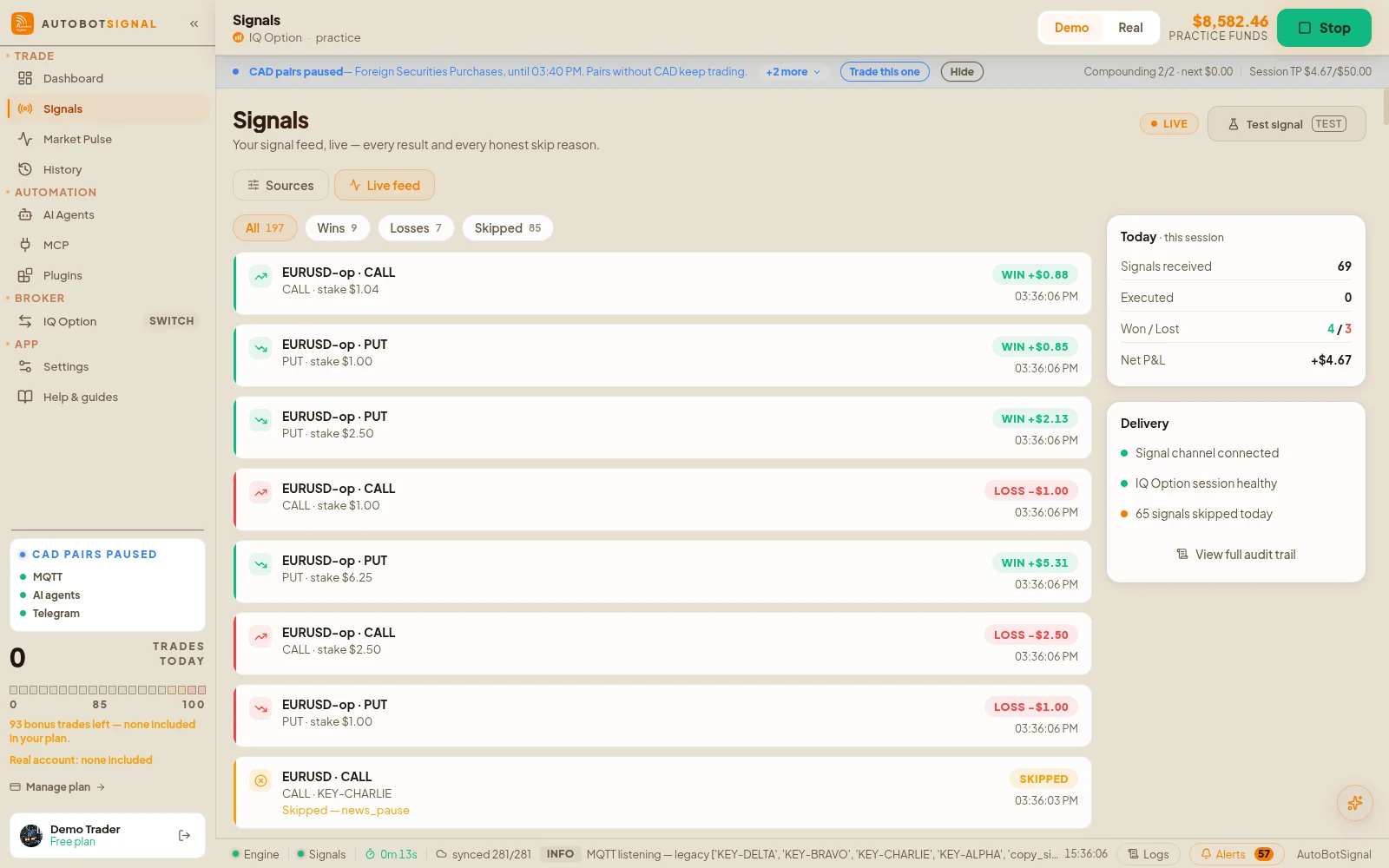
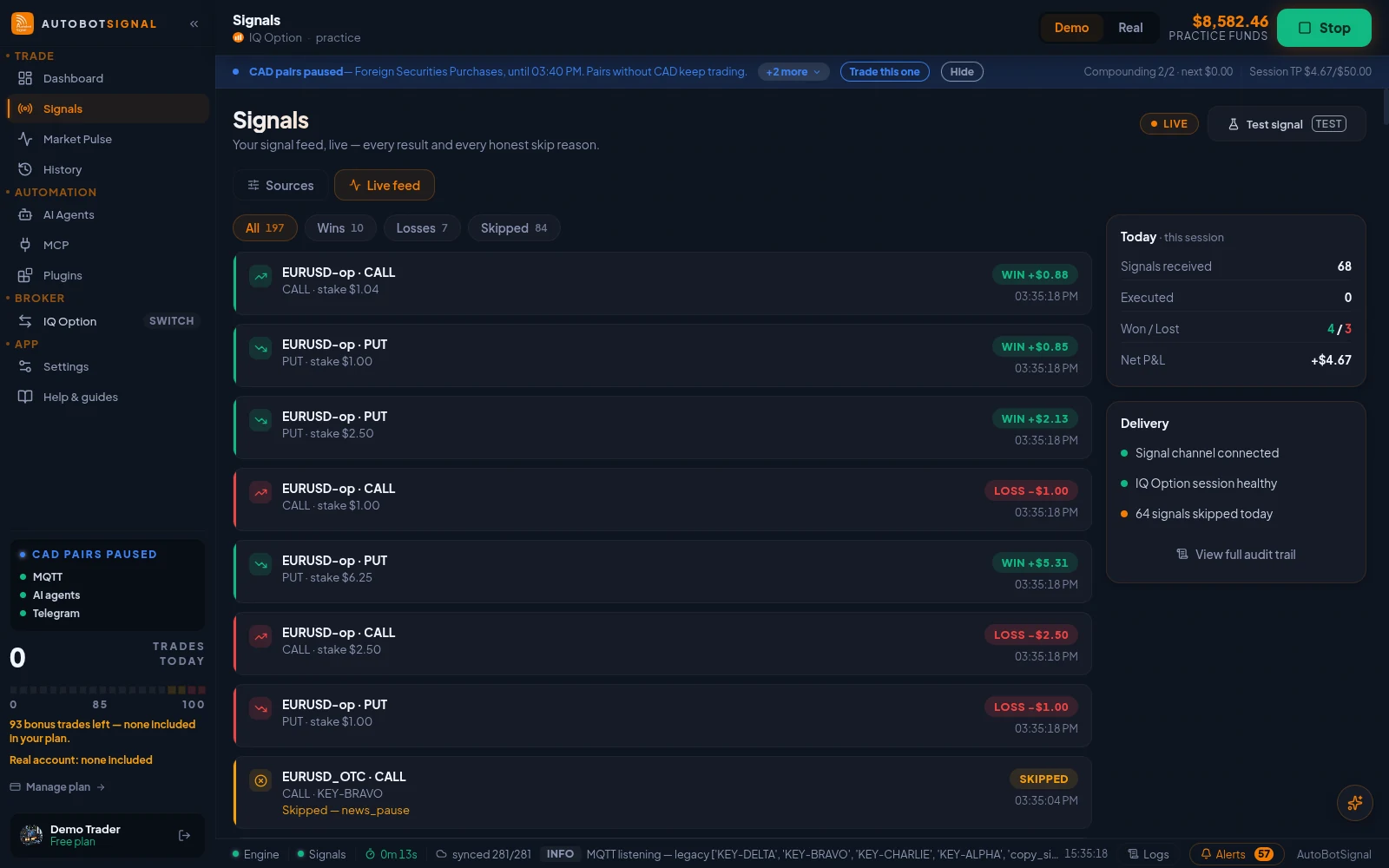
Signals → Live feed: every signal as it arrives, traded or skipped with the reason.
What this needs
Two things trip people up before they start: TradingView's free tier cannot send webhooks at all, and the desktop app has to be running to receive one.
TradingView plan
Paid tier
Webhook alerts are not on the free plan
Desktop app
Running + online
Windows, macOS or Linux
Message format
JSON
Free-form text cannot be parsed
Rate limit
100 / second
Per signal key; beyond that returns 429
What the alert message looks like
Copy the exact message from the desktop app — it is generated with your own signal key and the fields your setup expects. The shape is a single JSON object, and the `key` field is what routes the alert to your app.
{
  "key": "your-signal-key",
  "symbol": "EURUSD",
  "action": "buy",
  "expiry": "1m"
}
When an alert does not trade
In order of how often each one is the actual cause.
The alert fires in TradingView but nothing reaches the app
- Why
- The message is free-form text rather than JSON, or the signal key in it does not match the one in your app. The relay routes purely on that key, so a typo sends your alert into a topic nobody is listening to.
- Fix
- Re-copy the message from Signals → TradingView in the desktop app. Do not retype the key by hand, and do not add commentary around the JSON.
Webhook URL is greyed out in TradingView
- Why
- Webhook notifications are a paid TradingView feature. On the free plan the field exists but cannot be enabled.
- Fix
- Upgrade to a TradingView plan that includes webhook notifications. Nothing on our side can work around it.
The signal arrives but no trade is placed
- Why
- It was refused by one of your own rules — daily trade cap reached, stake above your limit, session not armed, or the market is closed for that instrument.
- Fix
- Open the trade journal. Every refusal is recorded with its reason, so you can see which rule stopped it rather than guessing.
Trades fire on the wrong instrument
- Why
- The symbol in the alert does not match the instrument you meant — most often an OTC and non-OTC pair being confused, since they are different markets with different prices.
- Fix
- Use the exact instrument name your broker lists. A signal only ever executes on the instrument it names; it is never re-routed to a similar one.
Alerts stop after a while
- Why
- TradingView expires alerts, and the desktop app must stay running and online. A closed laptop stops the session.
- Fix
- Re-arm the alert in TradingView and keep the app running for as long as you want the session live.
TradingView versus the other signal sources
TradingView is the right choice when you already have a chart setup you trust. It is not the only way in.
| TradingView | Telegram | Copy Trade | AutobotSignal AI | |
|---|---|---|---|---|
| You control the strategy | ||||
| Needs a paid plan elsewhere | TradingView paid tier | |||
| Setup effort | Moderate — alert per condition | Low — pick a channel | Low — add a key | Low — pick an agent |
| Works from your own indicator | ||||
| Your risk rules still apply |
Brokers a TradingView alert can trade on
Connect any of these in the desktop app and your alerts route to it.


Start on a demo account. Automated trading can lose money and no win rate or profit is guaranteed — you are responsible for the rules you configure.
Questions
You need a paid TradingView plan that allows webhook notifications on alerts. The free plan does not include webhooks, and there is no way around that from our side.
Automate your TradingView strategy
Install the desktop app, paste your signal key into an alert, and run it on demo first.